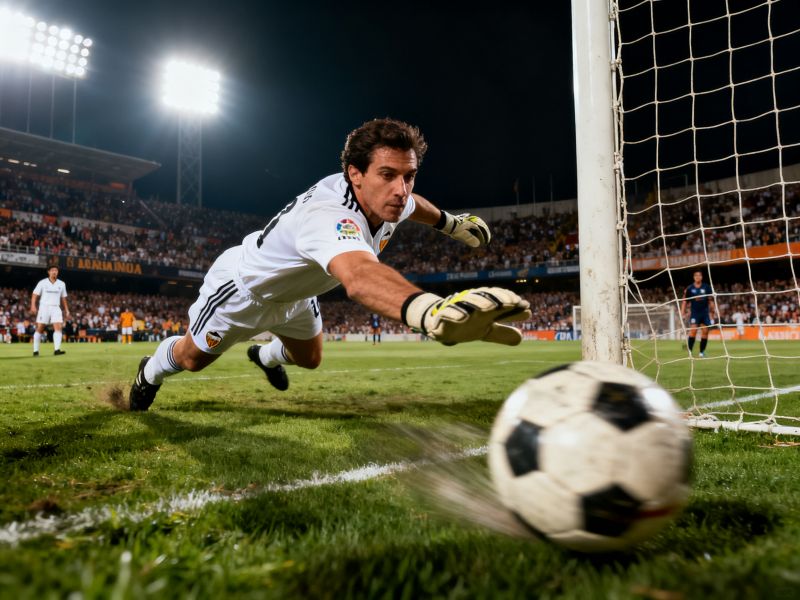
When Santi Canizares stepped between the posts for Valencia in 1998, few predicted that a relatively unknown keeper from Real Madrid's bench would become the club's most capped player in La Liga history. His debut season ended with a Copa del Rey title and a reputation for shot-stopping that bordered on the supernatural. That 1999 final against Atletico Madrid, where he saved a penalty from Juninho in the shootout, set the tone for a career defined by big moments rather than big talk.Canizares wasn't the flashiest goalkeeper. He didn't bark orders or perform theatrical dives for the cameras. What he did—with almost boring consistency—was position himself two steps ahead of the striker's thought process. Watch footage of Valencia's 2002 La Liga triumph and you'll notice how often he smothers a shot before it even becomes a highlight. His save percentage that season hovered near 78%, a figure that looks modest today but was elite in an era of heavier balls and rougher pitches. I'd argue his reading of crosses alone was worth ten points a season. That's not a stat you'll find on a spreadsheet;it's a judgment from watching him claim corner after corner with the calm of a man collecting his mail.Injuries were the one opponent Canizares couldn't outmaneuver. A freak accident with a bottle of aftershave in 2002—he sliced his foot open and missed the Champions League quarter-final—remains one of football's more absurd footnotes. He returned, of course, but the twinges in his back and knees began to accumulate. By 2006, the Canizares who had once dominated his box was conceding goals he would have eaten up five years earlier. Age is undefeated, as they say. Yet his leadership during that transition, mentoring younger defenders through chaotic matches。showed a dimension of his game that raw save data never captures.What sticks with me most about Canizares is his rivalry with Iker Casillas for the Spain shirt. For years, the debate split dressing rooms and bars alike. Canizares had the club consistency;Casillas had the big-tournament reflexes. Neither man publicly complained. That restraint feels almost quaint now, a reminder that competition doesn't have to be a soap opera. Canizares won 46 caps, a number that undersells his influence—he was the reliable understudy who pushed Casillas to greatness while never undermining him. You don't see that kind of professional grace often.
Since retiring in 2008, Canizares has largely avoided the managerial carousel. He pops up on Spanish radio as a pundit。offering blunt assessments that occasionally ruffle feathers. No diplomatic hedging. When Valencia's ownership chaos hit its nadir, he didn't hide behind a generic statement—he called the management 'a circus' on live air. That honesty is why Valencia fans still chant his name. For a generation raised on highlight-reel saves, Canizares represents something older: the value of quiet competence and speaking your mind only when it matters. His legacy isn't a statue outside Mestalla. It's the standard every Valencia keeper since has been measured against—and mostly fallen short.